
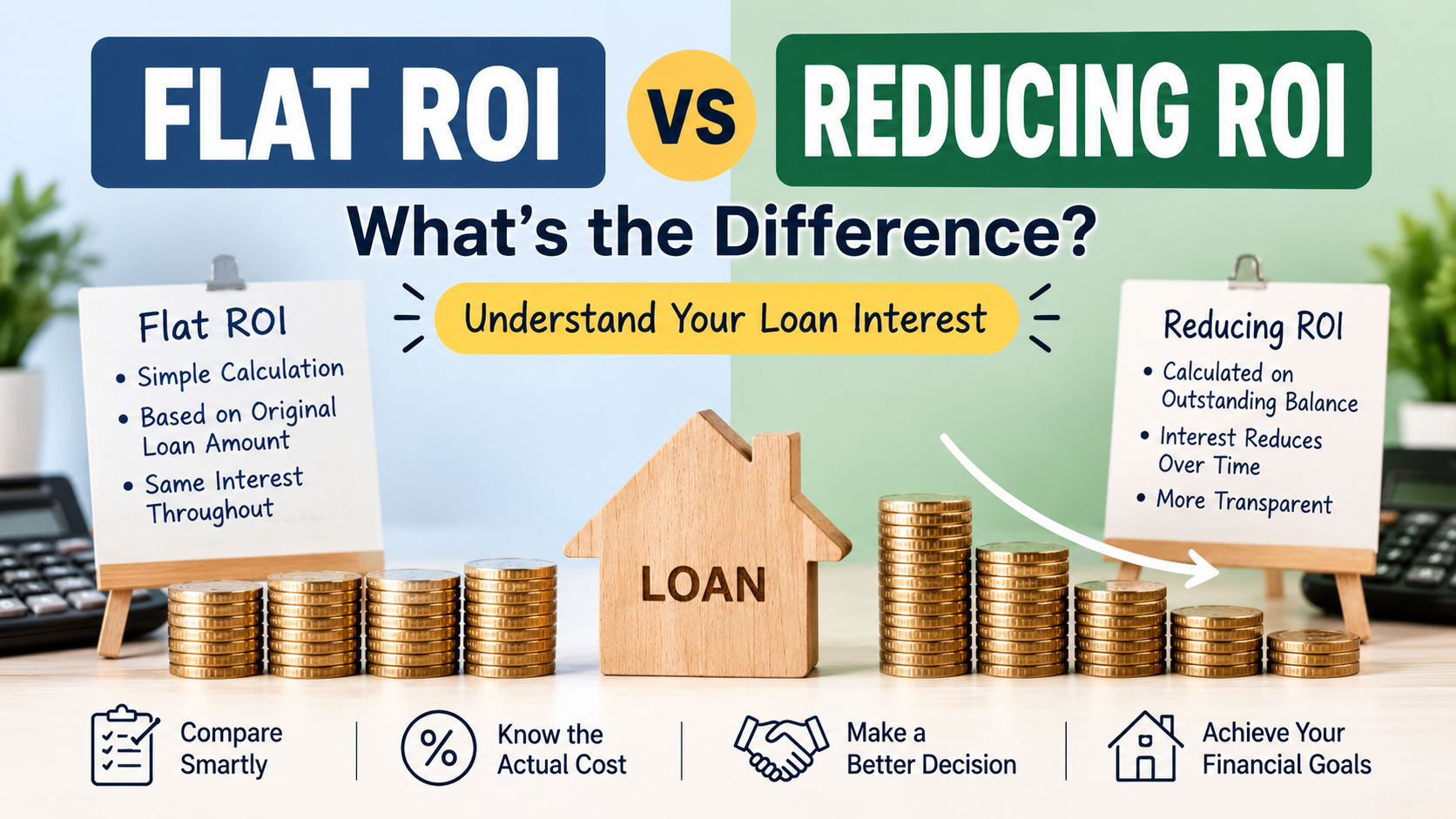
When you compare loan offers, you may come across terms like flat ROI and reducing ROI. Both are ways of calculating interest, but they can make a big difference to the total amount you repay.
A loan with a lower-looking interest rate is not always the cheaper option. The important thing is to understand how interest is calculated and how much you will actually pay over the loan tenure.
In this blog, we’ll explain the difference between flat ROI and reducing ROI in simple language, so you can compare loan offers more confidently.
What Is Flat ROI?
Flat ROI, also known as a flat interest rate, is a method where interest is calculated on the original loan amount throughout the repayment period.
This means that even as you repay your loan, the interest calculation is based on the initial principal amount. Your EMI may remain fixed, but the interest is not recalculated on the reducing balance.
For example, if you borrow ₹1,00,000, the interest may be calculated on the full ₹1,00,000 for the agreed tenure. The exact EMI and total repayment will depend on the interest rate, loan tenure, and lender’s terms.
Important: A flat ROI should not be compared directly with a reducing ROI just by looking at the percentage. The actual cost of the loan can be different.
What Is Reducing ROI?
Reducing ROI, also called a reducing balance interest rate, is a method where interest is calculated on the outstanding loan amount.
As you repay your loan through EMIs, the principal amount gradually decreases. Because the interest is calculated on the remaining balance, the interest portion also reduces over time.
For example, if you borrow ₹1,00,000 and repay part of the principal, the next interest calculation is based on the remaining loan amount rather than the original amount.
This is why reducing ROI is often considered a more transparent way to understand the interest cost of a loan. However, the actual cost still depends on the interest rate, tenure, fees, and repayment terms.
Flat ROI vs Reducing ROI: Main Differences
The main difference between flat ROI and reducing ROI is how the interest is calculated.
With flat ROI, interest is calculated on the original loan amount throughout the tenure. With reducing ROI, interest is calculated on the outstanding principal, which decreases as you repay the loan.
This means two loans with the same advertised interest rate may have different total repayment amounts. That’s why it is important to understand the calculation method before choosing a loan
Simple Example
Suppose you take a loan of ₹1,00,000. Under a flat ROI method, the interest calculation continues to use the original ₹1,00,000. Under a reducing ROI method, the interest is calculated on the remaining principal after each repayment.
The actual EMI and total interest will depend on the rate, tenure, and lender’s calculation method. So, always ask for the repayment schedule before making a decision.
Which Is Better: Flat ROI or Reducing ROI?
In many cases, reducing ROI can be more cost-effective because interest is calculated on the outstanding loan balance. However, the better option depends on the actual interest rate, loan tenure, and other charges.
A flat ROI loan may look simple because the interest calculation is based on the original loan amount. But the total repayment can be higher than expected if you compare it only with the advertised rate.
The best way to compare two loan offers is to look at the total interest payable and the total amount you will repay—not just the ROI percentage.
What Should You Check Before Choosing a Loan?
Before accepting a loan, take a moment to understand how the interest is calculated. Ask the lender whether the rate is flat or reducing, and check the total amount you will repay.
You should also compare the loan tenure, monthly EMI, processing fees, and any prepayment charges. These details can make a big difference to the overall cost.
If you are unsure about the calculation, ask the lender for an EMI schedule or a clear repayment breakdown. Understanding these details can help you choose a loan that fits your budget.
Conclusion
Flat ROI and reducing ROI are two different ways of calculating loan interest. Flat ROI uses the original loan amount, while reducing ROI uses the outstanding principal.
Before choosing a loan, don’t compare interest rates alone. Check the total interest, EMI, processing fees, and repayment terms to understand the actual cost.
A clear comparison can help you choose a loan that suits your financial needs and repayment capacity.
Frequently Asked Questions About Flat ROI and Reducing ROI
What is the main difference between flat ROI and reducing ROI?
Flat ROI calculates interest on the original loan amount, while reducing ROI calculates interest on the outstanding principal.
Which is usually cheaper, flat ROI or reducing ROI?
Reducing ROI is often more cost-effective because interest is calculated on the remaining loan balance. However, the actual cost depends on the rate, tenure, and other charges.
Can two loans with the same ROI have different EMIs?
Yes. If one loan uses flat ROI and the other uses reducing ROI, their EMI and total repayment amounts may be different.
What should I compare before taking a loan?
Compare the interest calculation method, total interest, EMI, processing fees, and repayment terms. Ask the lender for a clear repayment schedule.
Is reducing ROI always better?
Not necessarily. The actual cost depends on the complete loan terms, so compare the total repayment amount before deciding.